





Leucine is one of the most important essential amino acids for building and repairing muscle mass, and nuts are a great source for easily and deliciously incorporating it into your daily routine. At Nutnut, we like to think of it as the "trigger" that tells your muscles: now it's time to repair and grow, especially after training to improve athletic performance .
What does leucine do in your muscles?
Leucine belongs to the group of branched-chain amino acids, or BCAAs (along with isoleucine and valine), but it plays a particularly important role in muscle protein synthesis. It is responsible for activating the mTOR pathway, a kind of metabolic switch that signals to the muscle cell that there are enough amino acids available to begin repairing fibers damaged during exercise.
Once you consume a certain amount of leucine in a meal (around 2–3 g, according to dose-response studies), the anabolic signal becomes much stronger. It doesn't all have to come from nuts, but they all contribute steadily: almonds, peanuts, pistachios, and cashews provide leucine along with other essential amino acids, healthy fats, magnesium, and antioxidants, creating a very favorable environment for muscle recovery.
Leucine in nuts: how much does it really provide?
Nut proteins contain a significant amount of leucine, similar to other high-quality plant proteins. A 30g serving of many common nuts contains approximately 0.4 to 0.6g of leucine, depending on the type: peanuts and almonds are usually at the higher end of this range, followed by pistachios and other nuts with good protein content.
This means that, while a single serving of nuts won't reach the leucine threshold that maximizes protein synthesis, it works very well as a building block within your daily total. Combining them with other protein sources (dairy, legumes, eggs, soy, etc.) throughout the day helps you meet your leucine needs without necessarily resorting to supplements, which is especially appealing to those seeking more natural options.
Role of leucine in muscle recovery
After a strength training session or intense workout, your muscles are left with micro-damage and increased protein turnover. This is where leucine comes in: when it reaches the muscle in sufficient quantities, it activates mTOR and helps shift the balance towards protein synthesis rather than breakdown. Simply put, it helps repair muscle fibers so that, over time, you gain mass and strength.
Furthermore, leucine has proven particularly useful in combating age-related muscle loss (sarcopenia), because older adults require a stronger anabolic signal to achieve the same effect. Including nuts rich in protein and leucine as part of breakfast, snacks, or post-workout nutrition is a practical strategy for those who train regularly, but also for those who simply want to maintain their muscle mass as they age.
Leucine vs. isoleucine: how they are similar and how they are different
If you've already read our article about isoleucine in nuts , you'll know that both amino acids always work together, but they don't do exactly the same thing. Both leucine and isoleucine are BCAAs and participate in muscle recovery, but they divide the workload differently.
Leucine is primarily an anabolic signal: it tells the muscle "time to build," directly activating muscle protein synthesis. Isoleucine, on the other hand, is more involved in energy and metabolism: it helps improve glucose utilization and energy production during and after exercise, contributing to a better finish to your workout and faster glycogen recovery. You could say that leucine is the spark that ignites anabolism, while isoleucine ensures there is sufficient "fuel" and efficient energy management.
Regarding their presence in nuts, both appear together in plant proteins, but when we talk about muscle protein synthesis signals, leucine is clearly the key player. Isoleucine acts as a support: it improves the metabolic environment, facilitates performance, and helps make overall recovery (energy and muscle) more complete, as explained in your previous article on isoleucine.
Why nuts are a good vehicle for both
Although the absolute amount of leucine and isoleucine per serving isn't as high as in some animal proteins, nuts offer something we at Nutnut value highly: they combine essential amino acids with energy-dense nutrients and micronutrients that aid recovery. Magnesium, potassium, zinc, vitamin E , and polyphenols add to the effect of leucine and isoleucine, reducing oxidative stress from training and supporting proper muscle function.
This is especially useful for active people who struggle to reach their daily calorie needs to build muscle or who are looking for convenient and satisfying snacks. A handful of nuts before or after a workout can provide some of the leucine you need, some isoleucine for energy management, and at the same time help support joint, nervous system, and cardiovascular health.
The presence of leucine in each nut
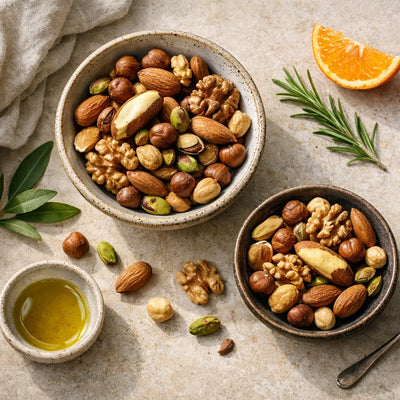
- Almonds : In almonds, leucine is one of the most abundant essential amino acids within their protein fraction, contributing significantly to the BCAA profile they offer per 100 grams. This makes them a particularly interesting nut when seeking to enhance muscle protein synthesis and recovery from plant-based sources.
- Walnuts : Walnuts provide a significant amount of leucine relative to their total protein content. Leucine is part of the branched-chain amino acid group, which supports muscle fiber repair. Its leucine content complements that of other nuts, helping to increase your daily intake of this key amino acid for muscle tissue.
- Hazelnuts : In hazelnuts, leucine is one of the essential amino acids present in their protein, contributing to the total BCAAs they offer. Although their total protein content is somewhat lower than that of other, more protein-rich nuts, they still provide a significant amount of leucine in a varied mix.
- Cashews : Cashews contain significant amounts of leucine within their amino acid profile, making them a useful plant-based source for increasing your intake of this essential amino acid through daily snacks. Their leucine contribution is especially valuable when combined with other protein-rich nuts.
- Pistachios : Pistachios provide leucine as part of their protein content, along with BCAAs that contribute to muscle mass recovery and maintenance. While they aren't the highest protein source, their leucine content still helps to increase your daily intake when consumed regularly.
- Peanuts : Peanuts are notable for their high protein content and, within that protein, for a significant amount of leucine, which is usually among the highest in the group of nuts and related legumes. Therefore, they are one of the most effective options for easily increasing leucine intake throughout the day.
How to use the leucine in nuts to your advantage
If the goal is to maximize muscle recovery, it's best to think of nuts as one more piece in your daily protein puzzle. You can:
- Add a 25–30g serving of protein-rich nuts (almonds, peanuts, pistachios, cashews) alongside a main protein source at lunch or dinner to add leucine to the total.
- Use them in the pre or post-workout combined with yogurt, enriched plant-based drink or legumes (for example, hummus with pistachio topping) to reinforce both the protein and energy aspects.
- Incorporate them into breakfasts and snacks if you are in a muscle gain phase and need more quality calories without resorting only to refined flours or sugars.
While leucine is responsible for activating muscle protein synthesis, isoleucine—also present in these same nuts—helps you better manage energy and arrive at your next workout with less fatigue. Together, and along with the other nutrients that nuts offer, they form a very interesting combination for anyone who sees training as an important part of their lifestyle.



Leave a comment
This site is protected by hCaptcha and the hCaptcha Privacy Policy and Terms of Service apply.