


When the goal is to lose weight, many people make the mistake of eliminating nuts due to their caloric density. However, scientific evidence and practical experience within the Mediterranean diet pattern demonstrate the opposite: when well-chosen and in the right amount, nuts can be great allies in fat loss, especially if you train and want to maintain your athletic performance.
At nutnut, we advocate for a clear vision: it's not just about counting calories, but about choosing foods with high nutritional density, capable of improving satiety, protecting muscle mass, and optimizing metabolism. And that's where nuts play a strategic role.
Why can nuts help you lose weight?
Although they are energy-dense, nuts have several characteristics that promote weight loss:
- High satiety thanks to their combination of fiber, plant protein, and healthy fats.
- Low glycemic index, avoiding insulin spikes.
- High thermic effect: part of their energy is lost in the digestive process.
- Protection of muscle mass thanks to their content of essential amino acids.
In fact, in our article on the Mediterranean diet, we already explained how regular consumption of nuts is not associated with weight gain when integrated into a balanced pattern.
Furthermore, if you train, eliminating healthy fats can negatively impact your performance and recovery, something we analyze in depth in the content about athletic performance.
The key is not to remove them, but to choose the best ones and adjust the quantity.
The best nuts for weight loss
1. Almonds: satiety and appetite control
Almonds are probably the most interesting nut when the goal is to lose body fat.
Why?
- High content of plant protein.
- Rich in fiber (key for the microbiota and satiety).
- Great source of antioxidant vitamin E.
- Good magnesium profile, which improves insulin sensitivity.
Their combination of protein and monounsaturated fat helps reduce hunger between meals. In addition, by protecting against oxidative stress—as we explained in the article on antioxidant properties—they promote better recovery after exercise.
Ideal as a pre-workout snack if you are in a caloric deficit.
2. Pistachios: fewer calories per serving and mindful eating
Pistachios have a practical advantage: being in their shell, they slow down consumption. This promotes greater awareness of the amount eaten.
Key benefits:
- Good protein/calorie ratio.
- High potassium content (important if you sweat a lot).
- Interesting profile of natural BCAAs.
In high-intensity or HIIT sports, their contribution of branched-chain amino acids—a topic we cover in depth in our article on BCAAs—helps preserve muscle mass while reducing fat.
Perfect for muscle definition phases.
3. Walnuts: strategic fats for fat loss
It may sound contradictory, but consuming the right fats helps mobilize body fat.
Walnuts stand out for:
- Their content of plant omega-3.
- Antioxidant polyphenols.
- Anti-inflammatory effect.
Chronic low-grade inflammation makes weight loss difficult. By reducing it, walnuts improve the metabolic environment. In addition, they protect the cardiovascular system, which is essential if you engage in resistance training.
Highly recommended for fat loss plans with high training volume.
4. Peanuts: protein power to maintain muscle
Although botanically they are legumes, nutritionally they behave like nuts and are especially useful when you want to lose weight without losing muscle mass.
They stand out for:
- High protein content.
- Good amount of leucine, key for muscle synthesis.
In our article on leucine, we explained how this amino acid acts as an anabolic "switch." When you are in a caloric deficit, preserving muscle is fundamental to keeping your metabolism active.
Very useful in body recomposition phases.
5. Cashews: stable energy without spikes
Cashews have a creamier texture and a slightly higher carbohydrate profile than other nuts, but they are still an interesting option:
- Good source of iron.
- Zinc for immune function.
- Presence of essential amino acids.
In weight loss phases combined with frequent training, maintaining stable energy is key to avoiding drops in performance.
How many nuts to eat if you want to lose weight?
The quantity is crucial. The general recommendation is:
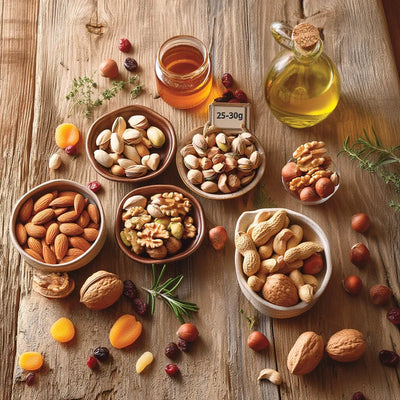
25–30 g per day (a small handful)
This provides:
- Sufficient satiety.
- Key micronutrients.
- Muscle support.
- Without exceeding calories.
Consuming them in place of ultra-processed snacks makes all the difference.
Nuts and athletic performance in caloric deficit
When you reduce calories, the body tends to lose both fat and muscle. This is where nuts make a difference.
As explained in the article on athletic performance, nuts:
- Provide sustained energy.
- Reduce oxidative stress from exercise.
- Contribute to muscle recovery.
- Support cardiovascular health.
Furthermore, thanks to their content of leucine, isoleucine, and valine—the branched-chain amino acids (BCAAs)—they help preserve muscle tissue even when the energy balance is negative.
Maintaining muscle means:
- Higher basal caloric expenditure.
- Better performance.
- Less rebound effect.
Practical strategies for losing weight with nuts
- Use them as a strategic snack: between meals to avoid hunger pangs.
- Add them to post-workout: combined with protein to enhance recovery.
- Substitute them for processed snacks: 30g of almonds is better than a sugary bar.
- Prioritize lightly roasted and natural: this way you better preserve their antioxidant properties.
Do nuts make you fat?
No, if consumed in moderation.
Weight gain occurs due to sustained caloric excess, not from a specific food. In fact, their satiating effect and positive impact on the microbiota—a topic we develop in the article on gut health—can promote better appetite regulation.
Conclusion: losing weight without losing strength is possible
The best nuts for weight loss are not those with the fewest calories, but those that best protect your muscle mass, stabilize your energy, and improve your metabolic environment.
If you train, the equation is clear:
- Almonds for satiety and antioxidants.
- Pistachios for portion control and BCAAs.
- Walnuts for an anti-inflammatory profile.
- Peanuts for protein support.
- Cashews for sustained energy.
At nutnut, we bet on premium nuts, carefully roasted, designed not only for enjoyment but also to accompany an active lifestyle.
Losing weight doesn't mean eating less. It means eating better.
And a good handful of nuts can be part of that smart strategy.


Leave a comment
This site is protected by hCaptcha and the hCaptcha Privacy Policy and Terms of Service apply.